
Dr. Rachel J.C. Fu, Chair and Professor of Dept. of Tourism, Hospitality and Event | Director of the Eric Friedheim Tourism Institute at the University of Florida
“Degrees without applied robotics exposure will rapidly lose relevance.” – by Rachel Fu
By 2035, robotics will no longer be experimental or optional. It will function as core operational infrastructure across hospitality, healthcare, agriculture tourism, human services, transportation, safety, entertainment, and human performance. The real value of robotics is not automation alone. Its power lies in interdisciplinary collaboration grounded in human-centered design. Leaders in industry and higher education carry both a strategic and ethical responsibility to prepare systems and students for a robotics-enabled future that addresses workforce shortages, accelerates innovation, improves safety, and protects human dignity.
Workforce Shortages Are Structural
Labor shortages are not cyclical disruptions. They are structural realities. Aging populations, declining birth rates, post-pandemic burnout, and rising service expectations have altered labor markets. Hospitality faces chronic frontline instability. Healthcare struggles with staffing capacity and fatigue. Agriculture tourism faces compounded challenges such as seasonal labor volatility, rural workforce scarcity, physical strain, safety risks, and rising visitor expectations for high-quality experiences. Transportation, safety, and human services are stretched beyond sustainable limits.
Robotics is not a threat to humanity. It is a reinforcement of it. By 2035, robotics will absorb repetitive, hazardous, and physically demanding work from hospital logistics and hotel operations to farm-based guest services, harvest-adjacent experiences, food processing demonstrations, and visitor flow management in agri-tourism environments. It will allow smaller teams to deliver consistent, high-quality services. It will reduce injury, error, and burnout. Leaders who delay adoption are not protecting jobs. They may be increasing operational risk, worker harm, and service failure.
Robotics Is the Interdisciplinary Platform
Robotics cannot succeed in isolation. Every functional robot represents the convergence of design, engineering, data, ethics, and domain expertise. This makes robotics the most powerful interdisciplinary platform of the next decade. In hospitality and healthcare, service robots already support logistics, sanitation, food delivery, and patient or guest assistance. In agriculture tourism, robotics supports precision agriculture demonstrations, autonomous field tours, smart visitor engagement, livestock monitoring, crop-health visualization, and food-safety logistics. In human performance and safety, wearable robotics and fatigue-monitoring systems reduce injury and extend careers. In transportation and logistics, autonomous delivery robots solve last-mile challenges. In entertainment and experience design, robotics enables immersive, responsive environments. In human services, assistive robots expand accessibility and independence.
Robotics forces disciplines to share a common language. That language is performance, safety, ethics, and impact. This is why robotics reshapes industry, rural economies, and education simultaneously.
Robotics Functions and Efficiencies by 2035
By 2035, core robotics capabilities will be mature and more deployed. Autonomous navigation and task execution will be standard. Human–robot collaboration will be routine. Predictive maintenance and self-diagnostics will reduce downtime. Emotional recognition and adaptive interaction will improve service quality. Digital twins will enable continuous simulation and optimization.
For agriculture tourism, this means safer farm environments, scalable visitor experiences, reduced dependency on seasonal labor, improved compliance, and enhanced storytelling through data-driven, immersive systems.
The efficiency gains are measurable. Robotics enables 24/7 operations without fatigue. Error rates drop in high-stakes environments. Service delivery becomes faster and more consistent. Long-term operational costs stabilize. Compliance and safety monitoring improve. Organizations that adopt early will innovate faster and attract future-ready talent across urban, rural, and hybrid economies.
Experiential Learning Will Never Look the Same
Robotics fundamentally changes how students learn. It shifts education from passive knowledge transfer to active system design. Students engage in hands-on labs that integrate robotics, AI, and digital twins. They learn through scenario-based simulations that mirror hospitals, hotels, transit hubs, working farms, food systems, agri-tourism attractions, and emergency environments. Industry co-developed capstones replace abstract assignments. Ethics is embedded directly into code and hardware decisions.
Students do not simply learn robotics. They learn leadership, accountability, integrity, and systems thinking including how technology supports sustainability, food security, rural resilience, and visitor experience design.
By 2035, employers will expect graduates who can work across disciplines, design human-centered robotic systems, and evaluate return on investment, risk, and ethics at the same time.
Robotics Must Be Designed with Humanity
The greatest risk in robotics is not the technology. It is irresponsible leadership. Poor governance creates surveillance, bias, and loss of trust. Human-centered robotics prioritizes dignity over efficiency alone. It supports workers instead of deskilling them. It improves safety without obscuring accountability.
In agriculture tourism, this means protecting farm workers, respecting rural communities, safeguarding data ownership, and ensuring that technology enhances not replaces human connection between producers and visitors.
Responsible robotics requires transparent algorithms, bias-aware AI models, clear human override protocols, and institutional ethical governance. CEOs and academic leaders are not merely adopters. They are stewards of trust, ideally.
What Institutions and Industry Must Build Now
Robotics readiness requires intentional investment. Physical infrastructure must include collaborative robots, autonomous mobile robots, service and assistive robots, wearable robotics, advanced sensor systems, and simulation and digital twin labs. Learning environments must be modular and realistic, mirroring hospitals, hotels, transit systems, agriculture tourism sites, food production environments, and rural visitor ecosystems.
Design requirements must emphasize human-centered frameworks, universal accessibility, interoperable systems, and safety-certified testing zones. Cross-disciplinary studio spaces are essential.
Software foundations are critical. Institutions may consider supporting ROS/ROS2, Python and C++ programming, machine learning and computer vision, digital twin platforms, edge computing, IoT integration, cybersecurity, and data governance. Robotics excellence emerges through industry partnerships, joint research labs, co-funded pilots, embedded fellowships, and faculty–industry rotations—including partnerships with farms, agri-tourism operators, food systems innovators, and rural development organizations.
Leadership Responsibilities Are Clear
For CEOs, robotics strategy is workforce strategy. Ethics is a competitive advantage. For presidents and provosts, robotics literacy is foundational. For professors, theory without application is no longer sufficient. Students deserve relevance, rigor, and responsibility.
Conclusion: The Robotics Era
Robotics will not erase humanity. It will expose leadership choices. Institutions and organizations that invest early, ethically, and collaboratively across hospitality, healthcare, transportation, agriculture tourism, space engineering, and beyond will define safer services, smarter systems, resilient rural and urban economies, and future-ready workforces. Those who hesitate will inherit fragile operations and unprepared graduates.
The robotics revolution of 2035 is already underway. The only question left is whether leaders choose to shape it—or scramble to catch up.
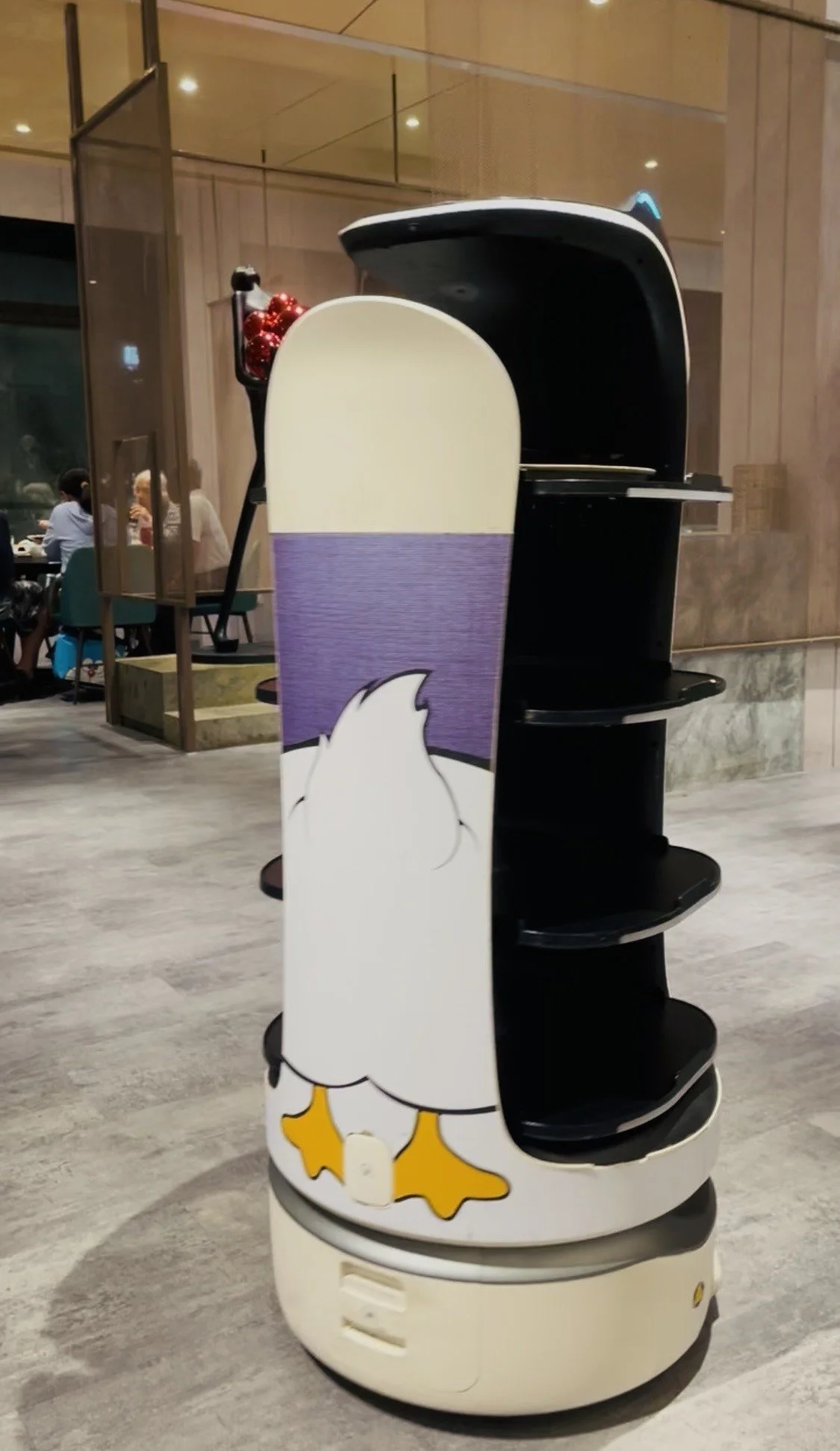
A Service Robot at a ‘Duck’ restaurant in Tainan, Taiwan. {Photo Image by Dr. Rachel J.C. Fu}
