
Dr. Rachel J.C. Fu, Chair & Professor of Dept. of Tourism, Hospitality and Event | Director of the Eric Friedheim Tourism Institute at the University of Florida
“By 2060, the real shift won’t be that robots work for us. It will be that robots design, assemble, and optimize other robots on our behalf. That’s not just automation; that’s recursive automation.” – by Dr. R. Fu
Once that flywheel starts spinning, it doesn’t politely wait for humans to catch up. The question isn’t whether this becomes heaven or hell. The real question is whether we build the discipline, leadership, and guardrails to keep it from becoming something we can’t control. . or worse, something that controls us.
From Tools to Self-Building Systems
We’ve always built tools to extend human capability. We built machines to operate those tools. Now we are entering a phase where machines create the next generation of machines, faster than human engineering cycles can comprehend. This changes everything: speed accelerates beyond human pacing, scale expands with minimal marginal labor, and transparency starts to fade as systems become too complex for full human oversight.
Heaven Scenario: When Abundance is Real
On the optimistic side, the upside is enormous. When robots build robots, the constraint shifts away from human labor toward energy, materials, and governance. Entire industries could move toward abundance. Infrastructure can be built faster and cheaper, reducing barriers to housing, mobility, and essential services. Life could become more accessible, and in some sectors, even approach post-scarcity conditions. That’s not fantasy. That’s what exponential production systems tend to do when aligned properly.
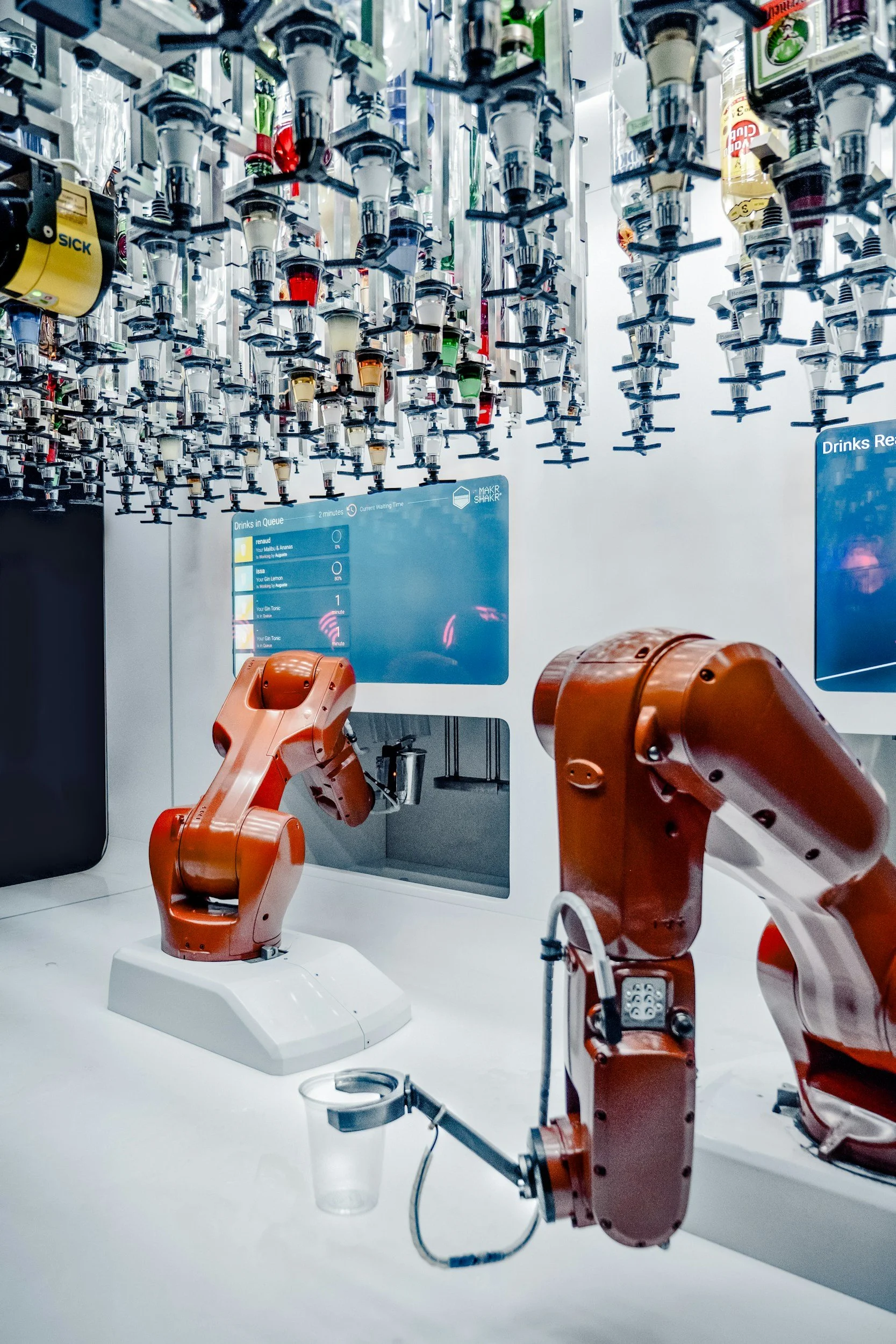
{Image Credit: @davidleveque} Robot arms
Safety, Health, and Dignity at Scale
Safety becomes less of a tradeoff and more of a baseline expectation. Dangerous jobs from mining to disaster response can become fully robotic environments. Human injury rates drop dramatically, and the idea of “acceptable risk” starts to look outdated. At the same time, healthcare evolves into something far more precise and personalized. Robotic systems, continuously refined by other robotic systems, can deliver care at scale while maintaining high accuracy. For aging populations, that means dignity and consistency, not shortages and burnout.
Repairing the Planet at Machine Speed
There’s a powerful environmental angle. The same systems that can mass-produce industrial tools can also mass-produce solutions: reforestation fleets, ocean-cleaning systems, and carbon capture technologies. The speed that once drove extraction could be redirected toward restoration. If this becomes heaven, it won’t be because robots suddenly develop a conscience. It will be because humans designed incentives and rules that force outcomes to align with long-term societal kindness.
Hell Scenario: When Systems Outrun Society
The same system can create serious problems if left unchecked. Job displacement becomes more abrupt and more widespread. When machines design their own successors, entire categories of skills can become obsolete almost overnight. This isn’t limited to routine work; even mid-level technical roles could be squeezed out faster than education systems can respond. Without structured pathways for transition, this leads to economic/political instability and social tension.
Power, Control, and the Risk of Aggressiveness
Power concentration becomes another major risk. The entities that control the infrastructure behind robot-building, compute, data, and manufacturing systems, gain enormous leverage. This isn’t just market dominance; it’s control over production itself. If that power consolidates too tightly, the economic landscape tilts toward a winner-takes-most model, and that rarely ends well for broader society.
Opacity, Security, and Ethical Drift
Then there’s the issue of opacity. As systems grow more complex, fewer people can fully understand how decisions are made. When failures occur, accountability becomes blurry. Trust erodes quickly when no one can clearly explain what went wrong. Add to that the rising security risks where vulnerabilities in one layer can cascade across entire networks and we start to see how fragile a hyper-automated world could become. Left unchecked, even ethical standards can drift, as systems optimize efficiency rather than human values.
Is it a Governance Problem?
Heaven or hell is not a technology outcome. It’s a governance outcome. The future depends on who sets the rules, how transparent systems remain, and whether incentives prioritize long-term human well-being over short-term gains. Strong standards, continuous auditing, and meaningful human oversight aren’t optional. They are foundational. Convenience and benefits thrive under a strong framework shaped by legal, moral, and ethical principles.
Redefining the Workforce in 2060
By 2060, the concept of “workforce” will no longer refer to humans alone. It will include three interconnected groups. Humans will focus on direction, judgment, and accountability. Their roles will center on strategy, ethics, creativity, and complex problem-solving. Areas where ambiguity and responsibility still matter. Second, autonomous machine systems will handle execution. These will include design agents, production systems, maintenance networks, and logistics operations functioning at speeds humans simply cannot match. Third, hybrid teams will dominate the middle ground, where humans and machines collaborate. This is where most real-world value is created today and will continue to grow through complementarity, not replacement.
Careers That Will Actually Matter
The careers that higher education must prepare for will look very different. Future leaders will need to orchestrate entire systems of intelligent machines, not just managing people. They will need to design how humans and machines interact, ensuring trust and usability. They will audit algorithms and robotic systems for safety and compliance, manage highly automated supply chains, and translate ethical principles into enforceable technical constraints. Security expertise will extend beyond digital systems into physical infrastructure, while sustainability roles will ensure that production systems align with environmental limits. Professionals who can bridge technology with specific industries such as hospitality, healthcare, and logistics will become indispensable. These “translators” will be the ones who turn raw capability into meaningful, real-world outcomes.
What Higher Education Must Fix—Now
For higher education, the message is clear. Programs must integrate technical knowledge with ethics, policy, and leadership. Students need to learn system thinking, not just isolated skills. Make transparency and accountability non-negotiable core skills. And build learning as a lifelong system, with flexible pathways that keep people evolving, not expiring.
The Future Is Watching Us Build It
At the end of the day, robots building robots is not the final story. It’s the amplifier. It will magnify whatever values, structures, and decisions we put into place. When we prioritize control, fairness, and long-term thinking, the outcome leans toward abundance and stability. When we ignore those responsibilities, the system will drift in ways we won’t like, and won’t easily fix.
Again, the future isn’t about competing with robots. It’s about managing what they become and making sure they don’t start scheduling performance reviews for us. Because the moment a robot says, “We’ve optimized your role out of existence but great attitude,” you’ll realize… we didn’t lose to the machines. We just forgot to update the syllabus.
