
Dr. Rachel J.C. Fu, Chair and Professor of Dept. of Tourism, Hospitality and Event | Director of the Eric Friedheim Tourism Institute at the University of Florida
“The defining question for higher education is no longer: ‘How do we prepare students for tomorrow?’ It is: ‘How do we empower students to invent tomorrow?’” – by Dr. R. Fu
The Age of Knowledge is Evolving into the Age of Creation
For generations, universities have served as society's guardians of knowledge, educating students and preparing future professionals. Those responsibilities remain essential. The world has entered a new era where access to information is no longer a competitive advantage. Artificial intelligence generates answers in seconds. Industries transform at unprecedented speed. Entire markets emerge and disappear within a few years. In this new reality, the institutions that thrive will not simply teach the future. They will create it.
From Classrooms to Innovation Launchpads
Universities possess one of the world's most valuable yet underutilized resources: human imagination. Every year, millions of students enter classrooms carrying fresh perspectives, bold ideas, and untapped solutions. Yet too often, those ideas remain confined to assignments, presentations, and forgotten projects. Imagine a different model.
Every classroom becomes an innovation studio.
Every capstone becomes a commercialization opportunity.
Every interdisciplinary collaboration becomes a potential startup.
Every student project becomes a pathway to societal impact.
Higher education must evolve from a knowledge-delivery system into an innovation-creation engine. The future economy will be built by problem-solvers who can identify opportunities and create solutions faster than ever before. Students are uniquely equipped to lead that transformation.
The Untapped Goldmine Sitting in University Classrooms
Unlike established industries, students are not constrained by decades of assumptions. They challenge conventional wisdom. They question outdated systems. They see opportunities where others see limitations. History repeatedly demonstrates that transformative breakthroughs often begin with individuals bold enough to imagine what others considered impossible. The next generation of:
Artificial Intelligence platforms
Healthcare innovations
Sustainable technologies
Tourism solutions
Hospitality systems
Mobility services
Consumer experiences
may already exist inside today's university classrooms. The opportunity is not a shortage of ideas. The opportunity is recognizing them early.
Why Investors Should Look Beyond Silicon Valley
For decades, investors have searched for innovation after companies were formed. The future demands a different approach. The most forward-thinking investors will spend less time chasing established startups and more time discovering emerging ideas where they begin: on university campuses. Students often identify trends years before markets recognize them. They understand evolving consumer behavior, emerging technologies, and new forms of digital engagement because they are helping shape them. Universities represent one of the largest untapped innovation pipelines in the world. The next billion-dollar company may emerge not from a boardroom, but from:
A classroom discussion
A student competition
A graduate thesis
A faculty research collaboration
An interdisciplinary innovation challenge
From Ideas to Impact: Closing the Commercialization Gap
Great ideas alone are not enough. Many student innovators possess extraordinary creativity but limited exposure to:
Intellectual property protection
Patent development
Licensing strategies
Startup formation
Regulatory compliance
Fundraising structures
Commercialization pathways
Bridging this gap represents one of higher education's greatest opportunities. Universities must build ecosystems that help innovators transform concepts into market-ready solutions. The goal is not simply innovation. The goal is impact.
The Rise of Intelligent Legal Services
The legal profession stands at the center of the innovation economy. Legal services have often been viewed as reactive, engaged after products are created and opportunities emerge. The future requires a different model. Legal professionals must become strategic innovation partners from the beginning of the creative process. Imagine a university ecosystem where:
Students generate breakthrough ideas.
Legal experts secure intellectual property.
Business mentors validate market opportunities.
Investors assess scalability.
Industry leaders test applications.
Faculty guide research development.
In such a system, classroom projects can rapidly evolve into commercial solutions. This should not be the exception. It should become the standard. These components create a powerful innovation ecosystem capable of generating economic growth, societal advancement, and global competitiveness.
Building the Innovation Ecosystem University
The universities that will define the next generation will seamlessly integrate:
Research. Generating new knowledge.
Entrepreneurship. Transforming ideas into opportunities.
Investment. Providing resources for growth.
Legal Innovation. Protecting and accelerating commercialization.
Industry Collaboration. Ensuring relevance and real-world impact.
Speed Has Become a Strategic Advantage
Ideas have limited windows of opportunity. Technological advantages are temporary. Markets evolve continuously. Institutions that move decisively will create disproportionate impact. Institutions that move slowly risk becoming observers of innovations developed elsewhere. This does not require sacrificing academic rigor. Rather, it requires combining rigor with agility. Universities must maintain excellence while creating pathways that allow discoveries to move rapidly from concept to implementation. The future rewards both quality and speed.
The Visionary Leadership Imperative
Technology alone does not transform institutions. Leadership does. The universities that shape the future will not necessarily be those with the largest budgets, the most buildings, or the longest histories. They will be those that cultivate visionary leaders. Leaders who:
Recognize opportunities before others do.
Embrace emerging technologies early.
Challenge conventional assumptions.
Build partnerships across disciplines.
Inspire others to pursue ambitious goals.
The greatest threat facing higher education is not change. The greatest threat is irrelevance. Visionary leadership transforms uncertainty into opportunity and possibility into progress.
Recruiting the Architects of the Future
Universities must become intentional about attracting, empowering, and retaining individuals who possess:
Imagination. The ability to envision what does not yet exist.
Courage. The willingness to challenge conventional thinking.
Adaptability. The capacity to thrive amid disruption.
Entrepreneurial Mindsets. The drive to transform ideas into action.
These leaders may emerge from faculty, administration, research laboratories, student organizations, alumni networks, and/or industry partnerships.
What matters most is their ability to bring people, ideas, and resources together to create meaningful impact.
A New Vision for Higher Education
The future university should graduate students with more than degrees. Students should leave with:
Patents
Prototypes
Intellectual property
Startup experience
Industry partnerships
Investment opportunities
Global networks
Solutions ready for implementation
Education should no longer be measured solely by what students know. It should also be measured by what they create.
Leading the Future, Not Following It
The world is entering an era defined by intelligence, innovation, entrepreneurship, and unprecedented speed. Students will generate the ideas. Researchers will create the discoveries. Investors will provide the capital. Legal professionals will accelerate commercialization. But visionary leaders will connect these forces and transform possibilities into impact. The question facing higher education is no longer whether change is coming. The question is whether universities will lead that change, or watch others invent the future for them. The future is already arriving. Now is the time for higher education to recruit visionary leaders, cultivate bold thinkers, build innovation ecosystems, and become the world's most powerful engine for creating what comes next. Go Gators!
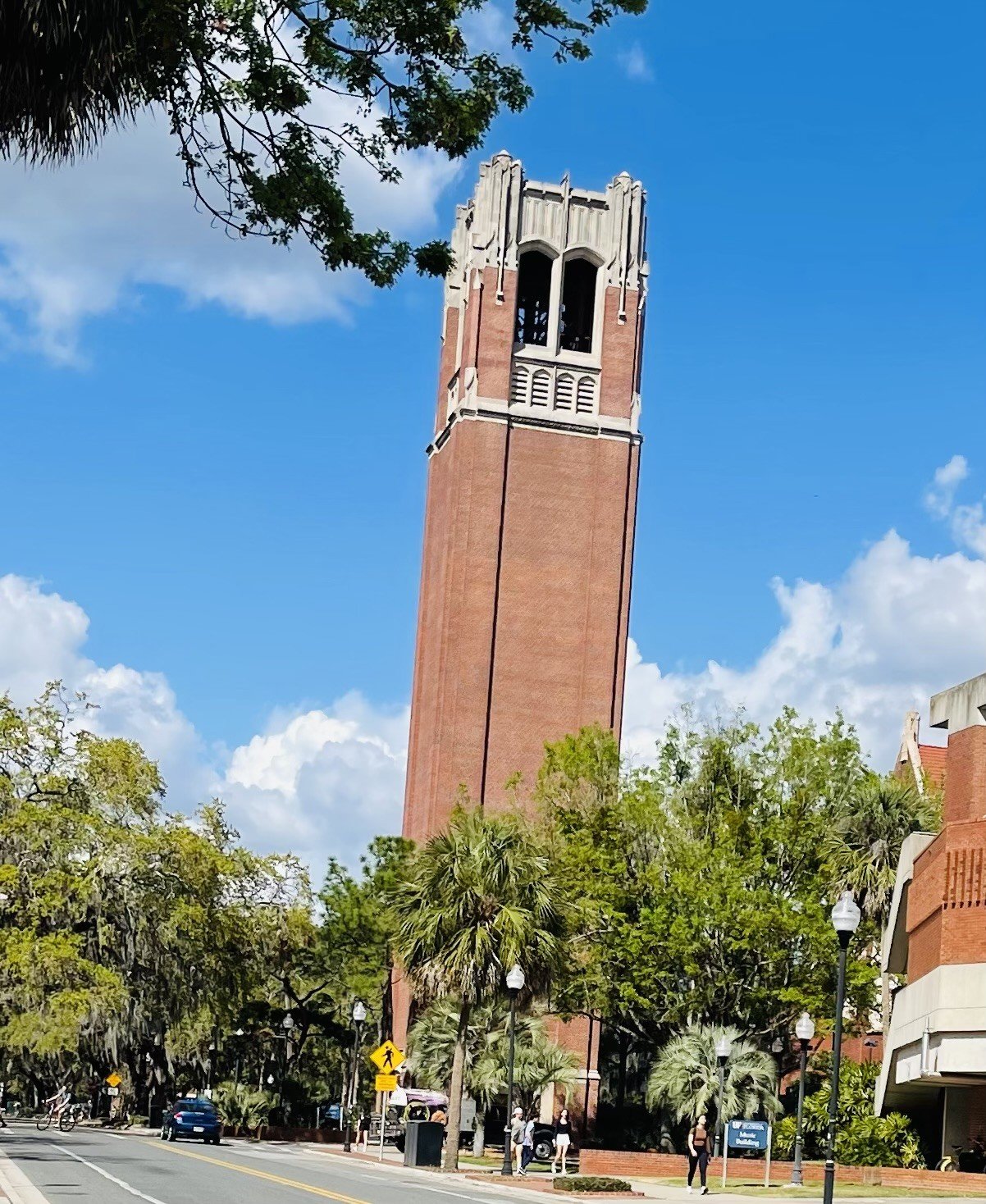
{Image Credit: Dr. Rachel J.C. Fu} The Belltower at the University of Florida
