
Dr. Rachel J.C. Fu, Chair and Professor of Dept. of Tourism, Hospitality and Event | Director of the Eric Friedheim Tourism Institute at the University of Florida
“Cruise itineraries used to be shaped by weather patterns, seasonal demand, and port popularity. Today, they are increasingly dictated by geopolitics, insurance viability, and security risk.” – by Dr. R. Fu
The cruise industry has long promised something rare in modern travel: certainty. Fixed itineraries, predictable ports, and curated experiences. You board, you relax, you arrive. But 2026 is delivering a wake-up call (again): the world’s oceans may be open, but the routes across them are no longer guaranteed.
Recent disruptions tied to escalating tensions in the Middle East, particularly around the Strait of Hormuz, have forced cruise lines to cancel sailings, reroute ships, and, in some cases, leave vessels temporarily stranded in Gulf ports. Athens-based Celestyal Cruises canceled all April 2026 departures after two of its ships, Celestyal Discovery and Celestyal Journey, were unable to safely reposition due to maritime disruptions. The Strait itself is not just another waterway, it is one of the most strategically critical chokepoints in the world, handling a significant share of global energy transport. When it becomes unstable, ripple effects are immediate and global.
This moment is not just a disruption. It is a structural shift.
Routes Are No Longer Just Geography. They’re Strategy. When tensions escalate in regions, cruise lines must make rapid decisions: cancel, reroute, or redeploy ships entirely. Insurance providers may withdraw coverage, port access may become uncertain, and maritime advisories can change overnight. The result is not minor inconvenience. It is full-scale operational recalibration.
Operational Fragility: When the System Pauses, Everything Pauses. Cruise operations are a masterclass in coordination. Ships, crew rotations, port bookings, fuel logistics, and guest experiences must align with precision. But that precision also creates vulnerability. When ships are unable to move: crew schedules are disrupted; supply chains stall; future itineraries collapse; and revenue losses compound quickly. The cancellations by Celestyal Cruises are a clear example. Multiple sailings wiped out in a single decision not because of demand, but because execution became impossible under current conditions.
The industry is learning, in real time, that efficiency without resilience is a risk.
Fuel, Costs, and the Pressure on Profitability. Geopolitical instability rarely travels alone. It brings cost volatility with it. Rising fuel prices linked to Middle East tensions are already impacting major operators, including Carnival Corporation, which has adjusted financial expectations in response to higher operating costs. Cruise lines are now navigating a difficult balance:
Absorb rising costs and protect demand
Or pass increases to consumers and risk pricing resistance
Traveler Confidence: The Most Valuable Currency at Sea. Beyond logistics and costs lies the most fragile element of all: trust. Thousands of travelers have recently faced itinerary disruptions, unexpected rerouting, or extended stays due to operational constraints. Even when cruise lines respond effectively, the psychological impact remains. Travelers begin to ask:
Will my itinerary actually happen?
What happens if my ship can’t return?
Is the risk worth the experience?
Confidence doesn’t disappear overnight but it evolves. And the cruise lines that understand this will be the ones that lead the next phase of the industry.
Opportunity Emerges: The Rise of “Safe Region Cruising.” When one region becomes unstable, another rises. As Middle Eastern itineraries fade, demand is shifting toward: The Caribbean; Southeast Asia; Australia and the South Pacific; and Domestic coastal cruises. This is not a decline. It is a redistribution. Cruise lines are repositioning ships accordingly, ensuring that capacity meets demand where travelers feel most comfortable. The industry has adapted. What’s different now is the speed of adaptation.
Flexibility Becomes the New Definition of Luxury. For decades, luxury in cruising meant certainty: fixed schedules, guaranteed destinations, and seamless execution. That definition is changing. Today’s premium experience is increasingly defined by flexibility: the ability to reroute without disrupting the guest experience; transparent, real-time communication; and Built-in contingency planning
Smarter Systems: A Long-Overdue Evolution. The cruise line industry is accelerating its investment in smarter systems. Expect to see:
Advanced risk modeling using real-time data
AI-supported route optimization
Diversified deployment strategies across regions
These tools are not just about avoiding disruption. They are about protecting brand reputation in an era where a single negative experience can travel globally within minutes.
Travel Smarter: A Practical Playbook for Cruise Travelers. The modern cruise traveler is not passive. They are informed, strategic, and adaptable. Here is how to navigate this new landscape with confidence.
Avoid High-Risk Regions. Even If They’re Still Listed. If an itinerary depends on politically sensitive waterways such as the Strait of Hormuz or the Red Sea, approach with caution. Brochures may not reflect real-time conditions.
Prioritize Flexibility Over Price. A lower fare loses its value quickly if plans change. Look for cruise lines that offer: flexible rebooking policies; clear refund structures; and strong communication practices
Understand Your Travel Insurance. Not all policies cover geopolitical disruptions. Carefully review what is included, especially regarding cancellations tied to conflict or government advisories.
Choose Operators with Proven Crisis Management. In uncertain conditions, the strength of the operator matters. The best cruise lines are those that: communicate early and clearly; provide efficient rebooking options; and demonstrate operational resilience.
Adopt a Flexible Mindset. The most successful travelers in today’s environment are those who understand that the journey may evolve. A rerouted itinerary can still deliver extraordinary experiences often in places you didn’t initially expect.
A New Era of Informed Exploration. The cruise industry is not in decline. It is in transition. The oceans remain as compelling as ever. The ships are still full. The desire to explore has not diminished. But the framework around that exploration has changed. Routes are no longer just lines on a map. They are strategic decisions shaped by global dynamics. Flexibility has replaced rigidity. Awareness has replaced assumption. For cruise lines, this is a test of resilience and innovation. For travelers, it is an opportunity to become more intentional, more informed, and ultimately more empowered. The experience of cruising is still very much alive.
In 2026 and beyond, the smartest travelers will not chase destinations. They will understand the world that shapes them.
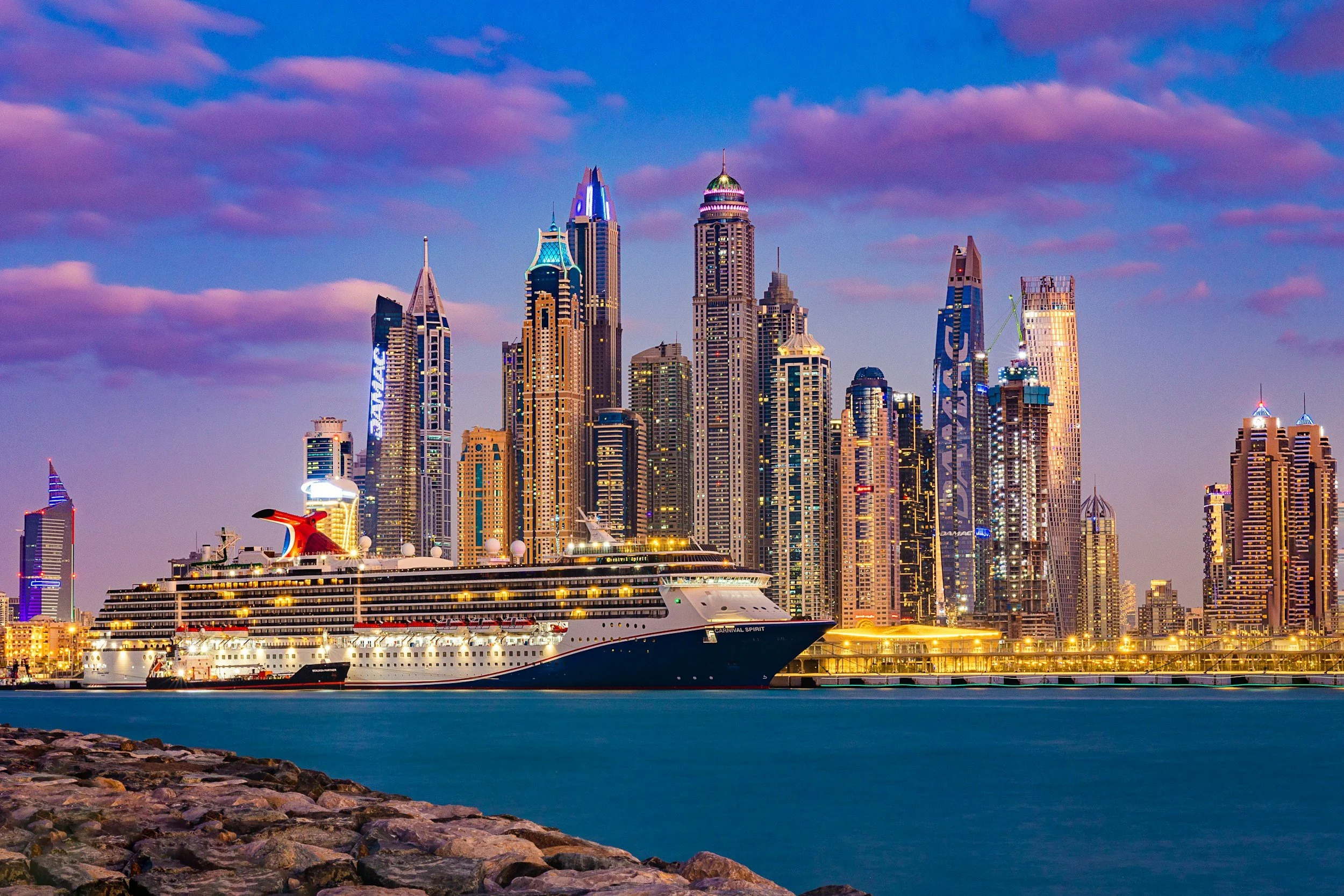
{Image Credit: @Allaria} A Cruise ship and city buildings.
