
Dr. Rachel J.C. Fu, Chair and Professor of Dept. of Tourism, Hospitality and Event | Director of the Eric Friedheim Tourism Institute at the University of Florida
“Universities, businesses, governments, and employees are entering a new era where degrees alone are no longer enough. Continuous upskilling, interdisciplinary thinking, adaptability, and emotional intelligence will define career survival and leadership. The classrooms of the future exist within the industries themselves.” – by Dr. R. Fu
The hospitality industry has always evolved alongside technology. From handwritten reservations to cloud-based hotel systems, from travel agents to AI-powered booking engines, every generation has faced disruption. Hospitality has survived because hospitality is fundamentally human. What changes now is the speed.
Hospitality Careers in 2030: The Age of Human + AI Collaboration
By 2030, AI will not fully replace hospitality employees, but it will reshape job descriptions. Many repetitive operational tasks will become automated, while human-centered roles will increase in value. The hospitality industry will operate through a “co-pilot economy,” where AI systems assist employees rather than fully replacing them. Hotels, cruise lines, airlines, resorts, restaurants, healthcare hospitality systems, and tourism organizations will further adopt:
AI-powered customer service agents
Smart concierge systems
Robotic room delivery
Predictive revenue management
AI-driven marketing personalization
Biometric check-ins
Voice-controlled guest rooms
Autonomous transportation services
Digital twins for event management
Smart kitchens and food robotics
Front desk staff evolve into “guest experience curators.” Revenue managers become “AI strategy analysts.” Event planners oversee hybrid physical-digital experiences enhanced by AI-generated simulations. Routine jobs with repetitive patterns will face the highest automation risks. Hospitality jobs requiring empathy, creativity, cultural intelligence, negotiation, leadership, crisis management, and relationship-building will remain highly valuable. A luxury hotel in 2030 may proudly advertise: “AI-powered efficiency with genuine human care.” That balance matters.
Hospitality Careers in 2040: Intelligent Ecosystems and Predictive Experiences
By 2040, hospitality businesses will likely operate as fully connected intelligent ecosystems.
AI systems will no longer simply respond to guests; they will anticipate behavior before guests even ask. Imagine arriving at a resort where:
Your preferred room temperature is already set
Your dietary restrictions are preloaded
Your entertainment interests are customized
Your transportation routes are optimized
Your stress levels are monitored through wearable technology
AI predicts when you may need wellness support
Hospitality organizations will use predictive emotional analytics, behavioral AI, and digital identity systems to personalize experiences at extraordinary levels. This era will create major demand for new careers such as:
AI hospitality ethicists
Human-machine interaction specialists
Digital wellness coordinators
Smart tourism strategists
Robotics operations directors
Hospitality cybersecurity managers
AI sustainability analysts
Immersive experience architects
Many traditional middle-management administrative roles may shrink due to automation. AI systems will perform scheduling, forecasting, inventory management, purchasing analysis, customer segmentation, and operational reporting more efficiently than humans. The workforce challenge of the 2040s will not simply be unemployment. The real challenge will be employability. Workers who fail to adapt may struggle. Workers who continuously upskill thrive beyond previous generations. That is the difference.
Hospitality Careers in 2050: The Rise of Augmented Humanity
By 2050, the hospitality industry will become deeply integrated with augmented intelligence and advanced robotics. Hotels and tourism systems will feature:
Autonomous robotic housekeeping
AI chefs and nutrition systems
Virtual destination simulations
Fully mixed-reality tourism
AI-generated event environments
Brain-computer interface personalization
Smart healthcare hospitality integration
Climate-adaptive tourism operations
Hospitality itself depends on emotional trust. A robot may deliver towels perfectly. But a grieving family member at a healthcare hospitality facility may still need a compassionate human presence. A machine may optimize a luxury experience. Human storytelling, empathy, and inspiration cannot easily be replicated. The future will reward individuals who combine:
technological literacy
emotional intelligence
ethical reasoning
strategic leadership
creativity
intercultural communication
The hospitality executive of 2050 will resemble a hybrid leader: part technologist, part psychologist, part strategist, part sustainability advocate, and part global diplomat. This is why future hospitality education must become beyond interdisciplinary.
Hospitality Careers in 2060: Humanity Becomes the Luxury
By 2060, AI and robotics will handle all operational labor across many sectors. When automation becomes common, humanity becomes premium. Luxury hospitality in 2060 will center around:
authentic human interaction
handcrafted experiences
authentic storytelling
cultural preservation
ethical tourism
spiritual wellness
sustainability leadership
personalized human mentorship
People will increasingly pay for experiences that feel genuinely human in a world saturated by synthetic systems. Future hospitality leaders will oversee both:
AI-powered operational systems
human-centered emotional ecosystems
That balance will define the elite organizations of the future.
How Higher Education Must Evolve
Traditional higher education models cannot remain unchanged. A university degree earned once at age 22 will no longer guarantee lifelong career security. Education becomes continuous, modular, stackable, and industry-connected. Universities must evolve from: “one-time degree providers” into “lifelong workforce innovation partners.” Future higher education systems include:
AI-integrated classrooms
adaptive personalized learning
digital simulation labs
virtual reality internships
industry co-teaching models
competency-based certifications
stackable microcredentials
AI ethics education
interdisciplinary curriculum structures
More industry leaders will be recruited as Industry Professors , such as Professors of Practice and Executive Professors, and their impact will become as important as that of traditional tenured and tenure-track faculty members. Professors themselves will evolve into:
mentors
innovation coaches
strategic facilitators
research translators
industry connectors
The strongest universities of the future will not compete only on rankings. They will compete on:
workforce relevance
industry integration
adaptability
innovation ecosystems
global partnerships
speed of curriculum redesign
Turning Uncertainty Into Opportunity
Every technological revolution creates fear first. The Industrial Revolution replaced manual labor. The Internet transformed communication. Smartphones changed human behavior. AI will redefine knowledge work. History repeatedly shows: new industries create new careers. The key question is not: “Will jobs disappear?” The better question is: “Will workers evolve fast enough?”
Students entering hospitality today should not prepare for one single career. They should prepare for multiple career reinventions across their lifetime. That means developing:
AI literacy
data interpretation skills
strategic thinking
leadership communication
innovation mindset
ethical decision-making
emotional intelligence
entrepreneurial adaptability
The future workforce must become comfortable learning continuously.
Degrees matter. Certificates matter. Adaptability matters, too.
The forthcoming Master of Science in AI-Driven Hospitality at the University of Florida UFJAX campus is expected to launch in January 2027 once the “white smoke” rises in June 2026 through final approvals from the UF Board of Trustees and the Florida Board of Governors. This future-forward program will prepare the next generation of leaders to master AI, robotics, predictive analytics, innovation strategy, and human-centered hospitality in a rapidly transforming global economy. Welcome aboard your future where technology meets humanity, and where Gators lead the industries.
Conclusions
The future of hospitality is not a battle between humans and machines. It is a redesign of how humans and intelligent systems work together. By 2030, AI will assist workers. By 2040, AI will predict and personalize experiences. By 2050, hospitality leaders will manage augmented ecosystems. By 2060, authentic humanity itself may become the ultimate luxury. The workforce of the future will reward people who embrace continuous learning, ethical leadership, technological literacy, creativity, and emotional intelligence. The winners will not necessarily be the most technical people. They will be the people who can connect technology with humanity.
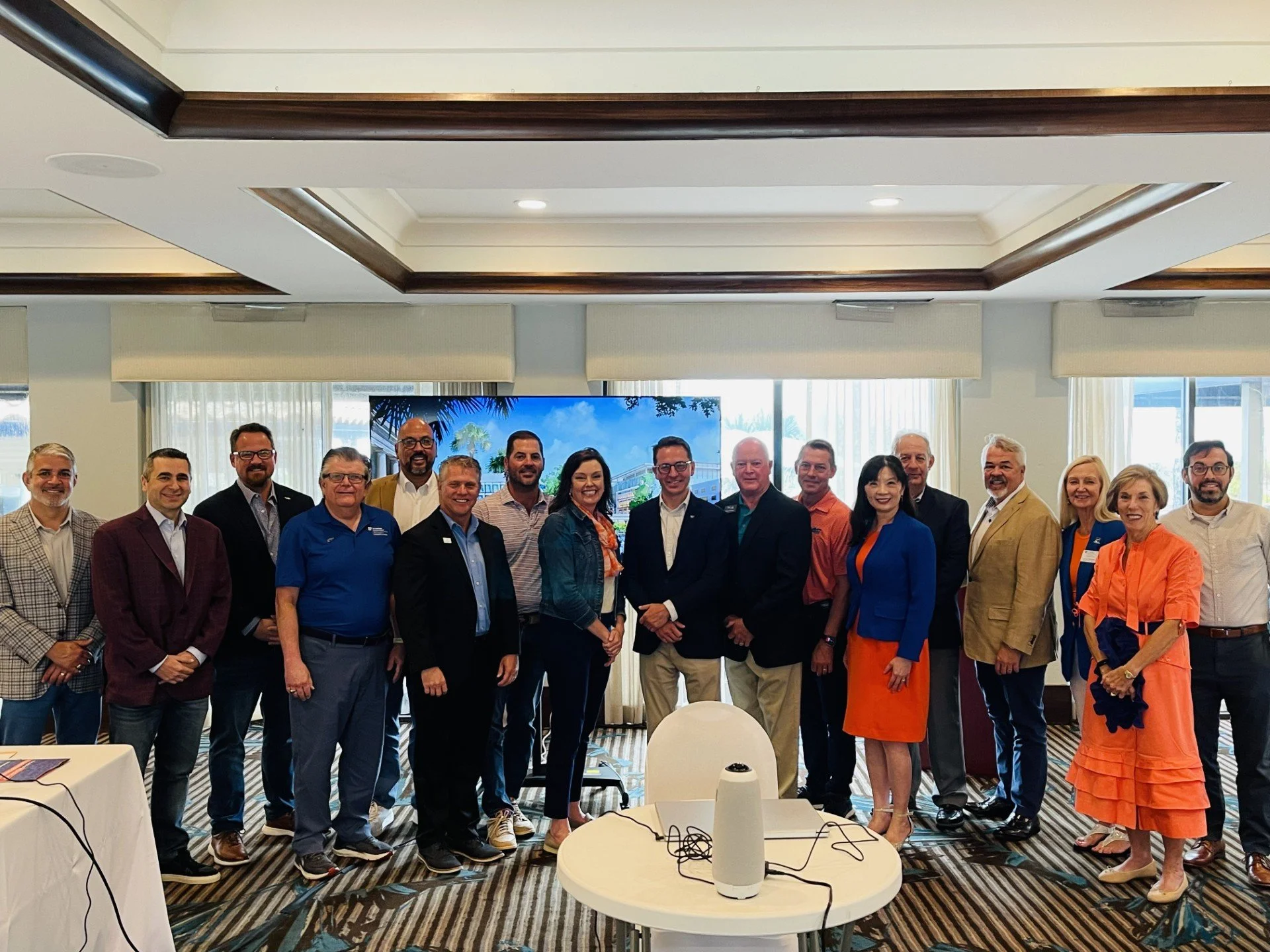
UF’s EFTI Industry Advisory Board members, UFJAX leadership, and the President of Visit Jacksonville gathered in Jacksonville, Florida, to discuss the future of the UFJAX campus and the forthcoming AI-Driven Hospitality degree and certificate programs.
